
Selected:

Monolec® Proprietary Liquid Additive…

Monolec® Proprietary Liquid Additive Technology

Monolec® Reduces Wear & Increases Film Strength

Monolec® is LE’s proprietary liquid wear-reducing additive that creates a single molecular lubricating film on metal surfaces, vastly increasing oil film strength without affecting clearances. An invaluable component in many of LE’s engine oils, industrial oils and other lubricants, Monolec® allows opposing metal surfaces to slide by one another, greatly reducing friction, heat and wear. The Monolec® name is derived from “mono-molecular,” which describes how molecules form a single (mono) layer on surfaces to protect against metal-to-metal contact. The science behind this technology dates back to the World War II era, when many of the original research documents were marked as classified. Seeing value in this research, LE refined the technology for use in its high-performance lubricants.


How Monolec® Works

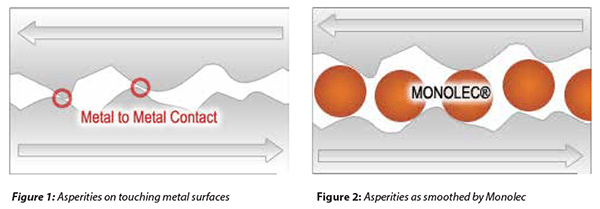
Even highly polished metal surfaces are far from smooth. Viewed microscopically, they resemble mountain ranges, with millions of jagged peaks called asperities. The distance between these peaks and valleys may be as much as 15 microns (a micron equals one-millionth of a meter). When metal surfaces slide against one another, especially under high pressure, frictional heat increases and causes the high points to tear and the lubricating film to rupture. This leads to seizure and the metal surfaces welding together.

Monolec® protects metal surfaces with a single layer of molecules, which reduce friction through their “ball bearing” action. If the oil film ruptures under high pressure, Monolec® will react with the quickly heating asperities to form a chemical synthetic lubricant that allows the high points to flow and reduces wear.

Monolec® also greatly increases the film strength of lubricating oils through a process called particulate attraction, which is the molecular attraction one particle has for another. Film strength is critical in preventing film rupture. Maintaining film strength reduces wear and provides for smooth, relatively friction-free operation.


Beneficial Qualities for Monolec®

  • Reduces wear
  • Reduces heat caused by friction
  • Vastly improves oil film strength
  • Disperses quickly and uniformly
  • Does not build up or fall out of suspension
  • Does not break down or become corrosive in use
  • Does not contribute to lubrication oxidation
  • Does not create deposits afftecting machine tolerances
  • Act synergistically to improve performance qualities of other lubricant components

‘Ball Bearing’ Action Smooths Asperities, Protects Metal from Friction

Monolec® liquid additive forming molecular layer on metal surfaces, reducing friction, increasing oil film strength, and minimizing wear
Viewed microscopically, even polished metal surfaces resemble mountain ranges, with millions of jagged peaks called asperities (Figure 1). Lubricated with a single layer of Monolec® molecules, the metal surfaces are much smoother and protected from friction through the ball bearing action of the molecules (Figure 2).


Particulate Attraction Increases Film Strength, Reduces Wear

Monolec® liquid additive reduces metal wear by increasing oil film strength through particulate attraction.

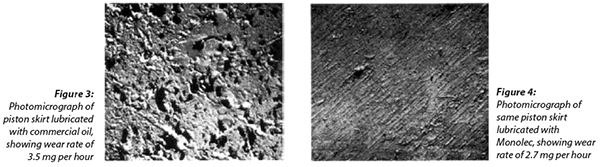
In addition to the ball bearing action, Monolec® greatly increases the film strength of a lubricant through particulate attraction. To measure only the wear-reducing ability of the Monolec® additive, a radioactive wear test was conducted. Visible proof of Monolec®’s ability to reduce wear is seen in the photomicrographs in Figures 3 and 4.

Figure 3 shows the surface of a piston skirt magnified 2,400 times, from a test engine run 480 hours on the control test oil without Monolec®. This engine had a wear rate of 3.5 milligrams per hour. Figure 4 shows a portion of an identical piston skirt also run 480 hours, using the same oil but with Monolec® added. It had only 2.7 milligrams of wear per hour. The Monolec® additive reduced metal wear by 24.2%, providing significantly smoother operation.

Products Containing Monolec®

More Exclusive Additives

Related Articles

News

Rethinking Common Approaches to Wire Rope Lubrication

Wire ropes are hard-working components in many different applications, from mines to lifts, ports, construction sites, and drainage systems.    Ron Byrnes, Senior Technical Sales Representative and Wire Rope Specialist at Lubrication Engineers (LE) South Africa, has over 30 years of experience working with wire ropes, including working directly on major

Read More »
Close-up of a milling machine with moving parts coated using a reliable general-use lubricant for smooth operation.
News

Why a Reliable General use Lubricant is so Valuable

While specialist lubricants can work wonders for a particular component in a specific type of equipment, a general use lubricant can be used in multiple processes and is one of the most important additions to a technical maintenance team’s toolkit. Used on all manner of things from conveyor belt bearings

Read More »
Rolled-up rusted wire rope, highlighting the importance of choosing the right lubricant for wire ropes.
News

Choosing The Right Lubricant For Wire Ropes

Wire ropes are critical parts of many operations. These components are often responsible for lifting, moving and carrying heavy loads. Just like any other mechanical component, they have to have the right product in them to work effectively. Gary Wentzel, Senior Technical Sales Representative for Lubrication Engineers (LE) South Africa

Read More »
Close-up of industrial machinery components lubricated with versatile lubricants for smooth operation.
News

Versatile Lubricants can be Effective in Heavy Duty and Lighter Applications

Good lubrication reduces friction, which in turn increases the lifespan of mechanical components. This is true for everything from mining equipment to bicycle chains. Often, commercial products that are used in intensive applications like wire ropes at mining and mining processing facilities aren’t always considered for other, less-intensive uses. However,

Read More »
×

Cart